Habitat
The green anaconda can be found in many places such as Venezuela, Columbia, Ecuador, Brazil, Northeast South America, and Trinidad. The green anaconda is very large is cumbersome on land, but it is very stealthy in water. The green anaconda likes to spend most of its time in muddy water waiting for the time to ambush prey. The green anaconda waits in muddy water and it also uses it’s time in a tree because it blends in well with a tree so they can start their ambushing. If you were going out to find a green anaconda you would find them in flooded forests floors, swamps, slow moving rivers, and the amazon.
Diet
The green anaconda eats lots of things, especially big animals, like large rodents, deer, fish, peccaries, capybaras, tapirs, turtles, birds, dogs, sheep, caimans, and jaguars. The green anaconda is able to unhinge their jaw and swallow their food headfirst no matter what the size is. When green anacondas eat large meals it will take time to digest and can take them weeks to months to digest.
Threats
When it comes to the top of the food chain, the green anaconda does not necessarily have natural predators. The green anacondas do have a fear of humans. Humans are a big threat to the green anaconda because humans are afraid that they will attack them and they want to protect themselves. Humans also kill green anacondas for their skin. That skin can be used for decoration or leather. The green anaconda is also losing their habitat due to deforestation.
Giant prehistoric snakes of ancient times.
There were two types of giant snakes. The Gigantophis was one thousand pounds and was thirty-three feet long. They are part of the family of Madtisio. The other one was The South American Titanoboa. The South American Titanoboa is fifty feet long and weighs as much as a ton. It also ate giant Prehistoric crocodiles.
Earlier snakes of prehistoric times.
The first snakes were in the craetasues period. There were four of them. The Najash, the Pachyrhachism, the Haasiophism and the Eupodiphis. They all lived in the Middle east except, the Najash who lived in South America. They only had two stubby legs. We think they may have evolved from the Mosasaurus.
Basic facts about the Green Anaconda.
Green anacondas scientific name is Euncties murinus. Green anacondas lie in the water at night to ambush prey. Green anacondas are constrictor snakes. That means when they bite something there prey doesn’t get poisoned. After they bite it, they coil around it to strangle it. They usually kill smaller animals but if there habitat has bigger animals they can also eat those. Green anacondas take what they killed into the water to make sure biting ants don’t get to the carcass. They also do this, so the smell doesn’t attract Jaguars. People kill them because they want their skin.. Green anacondas are not aggressive. Green anacondas are also one of the biggest snakes in the world.
Size
Green anacondas can get to thirty feet long. They are the biggest of the anaconda species. They can weigh about five hundred kilograms which is 1100 pounds. Females are much larger than males. They have circle and oval spots that are yellow and black. Green anacondas are an olive brown color.
Fun facts about the Green anaconda.
Green anacondas scientific name means Good Swimmer in Latin. They live thirty years in captivity and around ten in the wild. Green anaconda babies are two feet long. Green anacondas give live birth. Green anacondas can breathe under water for up to ten minutes. They are the heaviest snake in the world. Green anacondas are cannibals. Some Green anacondas side wind. There windpipe comes out when they eat so much they cant breathe.
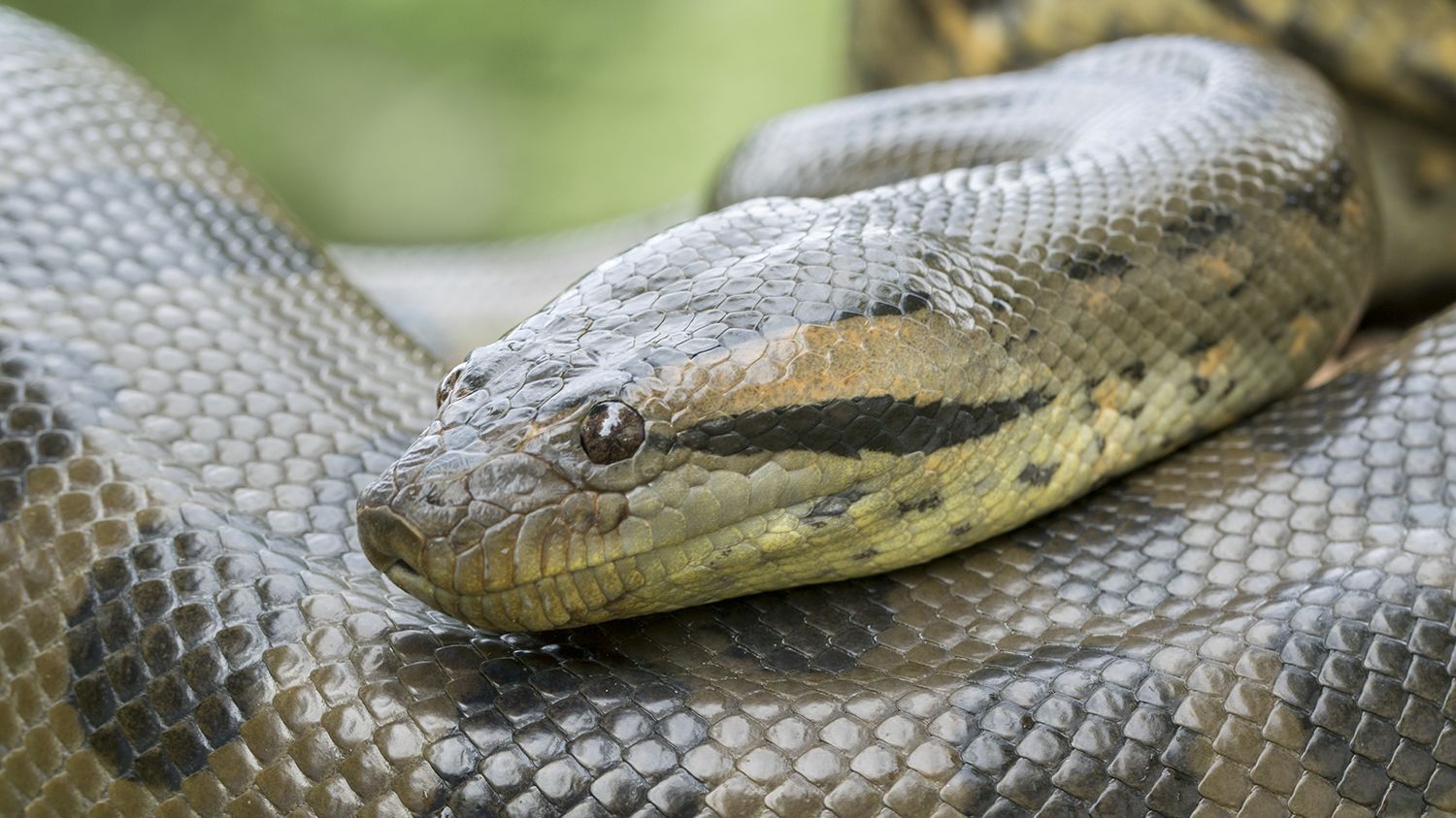
Green anaconda
 snake stuff